If your media spend is higher than it was two years ago and growth still feels harder, you’re not mismanaging the account. You’re operating inside a different economic reality.
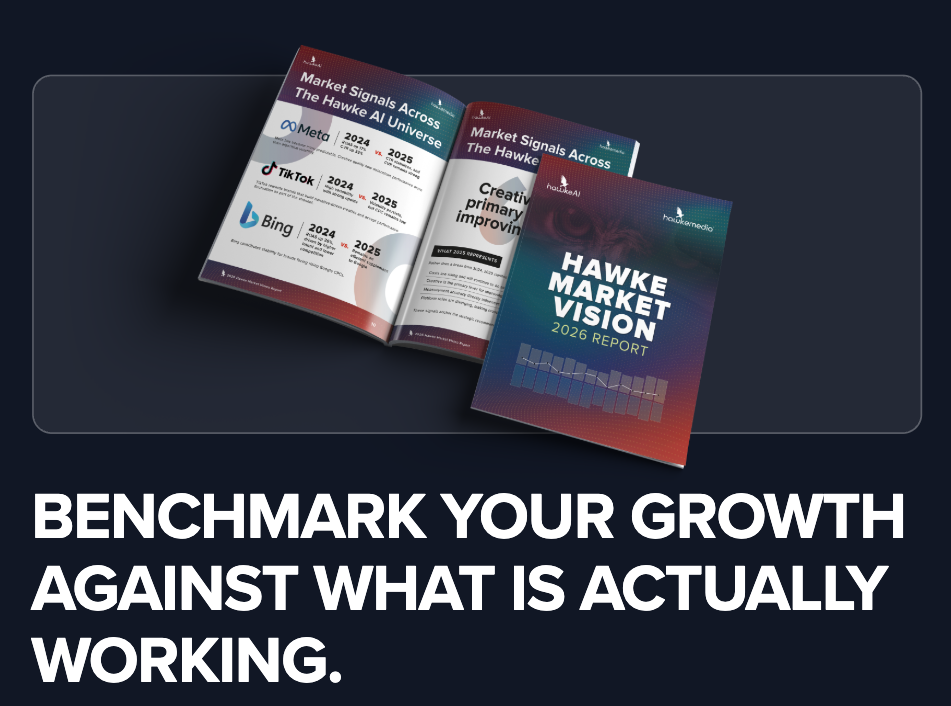
Hawke Media’s 2026 Market Vision Report puts real scale behind what most performance teams have been feeling quietly. The analysis spans 17.9 billion impressions, 321 million clicks, and $313 million in ad spend.
The takeaway is blunt: consumer demand hasn’t collapsed. What’s changed is how growth actually happens when costs are structurally rising.
The report doesn’t blame algorithms. It doesn’t point fingers at privacy updates. Instead, it shows that performance has shifted away from targeting and toward systems. Creative velocity, funnel design, and cross-channel orchestration now determine who scales and who stalls.
That distinction matters because many teams are still optimizing like it’s 2021.
Demand is still there. Efficiency is not.
One of the most important clarifications in the report is also the least comforting. Rising costs aren’t a temporary spike. They’re structural.
Across billions of impressions, Hawke found that consumer engagement remains strong. Click volume hasn’t fallen off a cliff. What has changed is the price of participation. CPMs are higher across platforms, and the margin for error is thinner.
That’s a dangerous combination for teams still treating performance as a bidding problem. When demand exists, but costs rise, the winners aren’t the brands with the smartest knobs and levers inside ad platforms. They’re the ones extracting more value from every interaction.
This is where the shift begins.
Algorithms stopped being the differentiator.
For years, outperforming meant understanding platform mechanics better than your competitors. Smarter audience construction. Faster learning phases. Cleaner attribution.
Hawke’s data shows that the edge has compressed. With modern machine learning, most advertisers are operating with roughly the same optimization power. When everyone has access to similar algorithms, the algorithm itself is no longer the advantage.
The implication is uncomfortable but freeing. If targeting isn’t the primary growth lever anymore, teams can stop obsessing over marginal platform tweaks and focus on the parts of the system they actually control.
That’s where creative velocity shows up first.
Creative velocity is the new cost control.
One of the clearest signals in the Market Vision Report is the direct correlation between creative throughput and sustained performance.
In a rising-cost environment, ads fatigue faster. Not gradually. Abruptly. Hawke’s analysis across large spend portfolios shows that many “winning” creatives peak quickly and decay within days.
Brands that rely on a small set of hero ads see performance swing wildly. Brands that ship creative continuously stabilize results even as CPMs climb.
This isn’t about making better ads in isolation. It’s about volume, variation, and speed. Teams producing consistent new angles, formats, and hooks give the algorithm options. That optionality becomes a form of risk management.
We see this constantly in practice. E-commerce brands spending mid-to high-six figures per month don’t win because they found a magic ad. They win because they built a machine that never runs out of tests.
Creative velocity isn’t a brand exercise anymore. It’s a performance requirement.
Funnel design is now part of acquisition.
The report also highlights a shift many teams are slow to accept. Post-click experience now shapes pre-click performance.
When signal is limited, platforms rely heavily on downstream behavior to optimize delivery. That means your landing pages, onboarding flows, and offer sequencing feed back into who sees your ads next.
Hawke’s data shows that brands with aligned funnels consistently outperform those that treat conversion rate optimization as a separate initiative. The difference compounds at scale.
Small friction points matter more when costs rise. Message mismatch matters more. Weak offers don’t just convert poorly. They degrade learning.
This is why teams that invest in funnel clarity often see improvements without touching bids or budgets. They’re not “optimizing conversion.” They’re improving the signal the platform uses to find the right users.
In 2026 economics, CRO and acquisition are the same conversation.
Channel-by-channel thinking is losing.
Another structural shift in the report is how clearly unified acquisition outperforms siloed execution.
Hawke’s analysis shows that brands treating performance as a single system across paid social, search, lifecycle, and retention generate better outcomes than those optimizing each channel independently. Not because attribution suddenly works, but because decision-making improves.
When creative insights travel across channels, messaging reinforces itself. When offers are coordinated, demand compounds instead of fragmenting.
We’ve seen this play out with B2B teams running Google Search and LinkedIn in parallel. When the narrative diverges, performance plateaus. When both channels echo the same positioning and proof points, conversion lifts across the board.
The channel isn’t the strategy. The orchestration is.
Performance has a new definition.
One of the most subtle but important reframes in Hawke’s Market Vision is how it defines performance itself.
In a rising-cost economy, short-term efficiency without durability is fragile. The brands pulling ahead are looking at blended acquisition costs, lifecycle contribution, and system-level efficiency, not just ad-level ROAS.
That doesn’t mean ignoring near-term metrics. It means understanding their limits. Platform attribution is directional. Incrementality matters more than precision. Trends matter more than screenshots.
This shift is often where internal friction shows up. It requires educating stakeholders. It requires explaining why a campaign that looks worse in isolation might strengthen the system overall.
But the data suggests that teams who make this transition earlier build resilience that others can’t catch up to.
This isn’t a tactics problem; it’s an operating model problem.
The hardest truth in Hawke’s report is that none of this is fixable with a single playbook tweak.
The brands adapting fastest have restructured how growth work gets done. Creative sits closer to media. Lifecycle owns revenue impact. Testing velocity is resourced intentionally, not squeezed in.
That’s not easy, especially for lean teams. But the alternative is trying to force old mechanics to work in a new economic reality.
Rising costs aren’t going away. The question is whether your growth system can absorb them.
The real signal from the 2026 market vision
Hawke Media’s analysis of 17.9 billion impressions, 321 million clicks, and $313 million in spending doesn’t predict the future. It documents the present.
Growth still exists. Demand is still there. But the leverage points have moved.
Creative velocity, funnel design, and cross-channel orchestration aren’t trends. They’re responses to a structural shift in modern marketing economics.
If you’re still treating performance as a channel problem, 2026 will feel expensive and unpredictable. If you start treating it as a unified system, you at least give yourself a fighting chance.
That’s the new playbook. Not because it’s fashionable, but because the data says everything else is getting harder.