Our world today is overrun with digital distractions, and with the advent of AI, there has been a sharp increase in “AI slop” games that drain attention and provide nothing of value.
Meisa Chen wants to solve that gap through her studio, Biscuit Games, which believes that gaming is the single best way to deliver meaningful experiences that translate into real-world skills. Their flagship title, Palmier Island, embodies that philosophy by featuring language learning: incorporating French dialogue into a gaming narrative with character-driven moments, where players learn because the world pulls them in, not because the game tells them to study.
Meisa Chen’s Early Path To Biscuit Games
Before joining the video game world, Meisa Chen gained experience across a multitude of industries, including working in international modeling, quant trading, and even becoming CTO of a sustainable-housing startup.
The inspiration for Biscuit Games traces back to a month in Milan, where she picked up Italian by having daily exchanges with locals at a neighborhood bakery, an experience she describes as giving her “accidental fluency.”
She then started looking for a project that could bring forward on a larger scale the same intuition those real-world conversations taught her. At an Oregon founders’ retreat, the studio’s ethos surfaced clearly: she came to realize that her learning was natural when it was attached to something other than the mere notion of learning something. This became the start of a principle she now calls “nutritious games.”
Biscuit Games now takes that idea into the video game world: a game that takes fun and education not as competing ideals, but parallel systems that feed off one another. “I wanted to make games that become part of people’s childhoods,” she explains. “A cozy island you come home to each day to play with something meaningful: a real-world transferrable skill.”
The Company’s Leading Game: Teaching French With Palmier Island
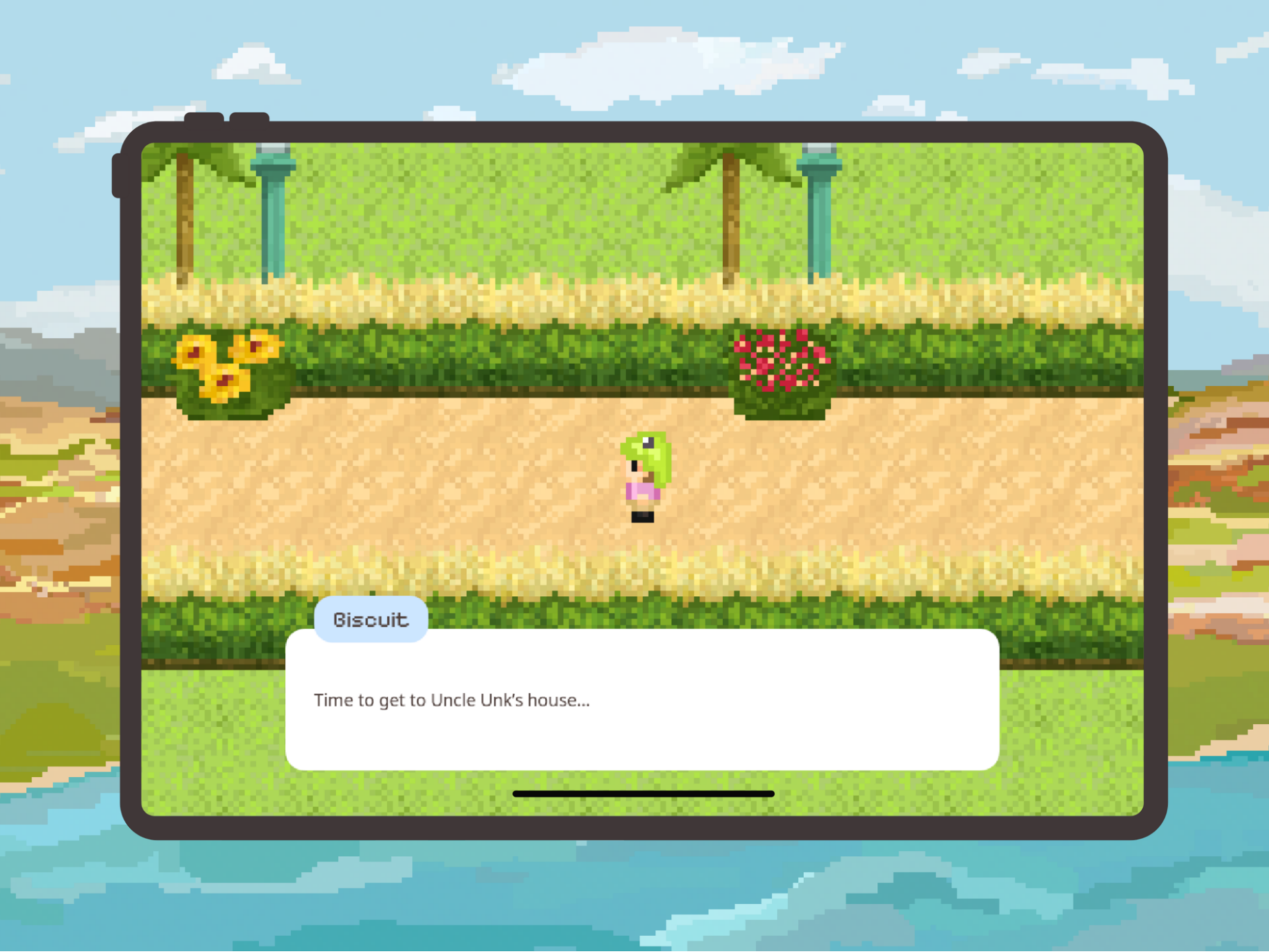
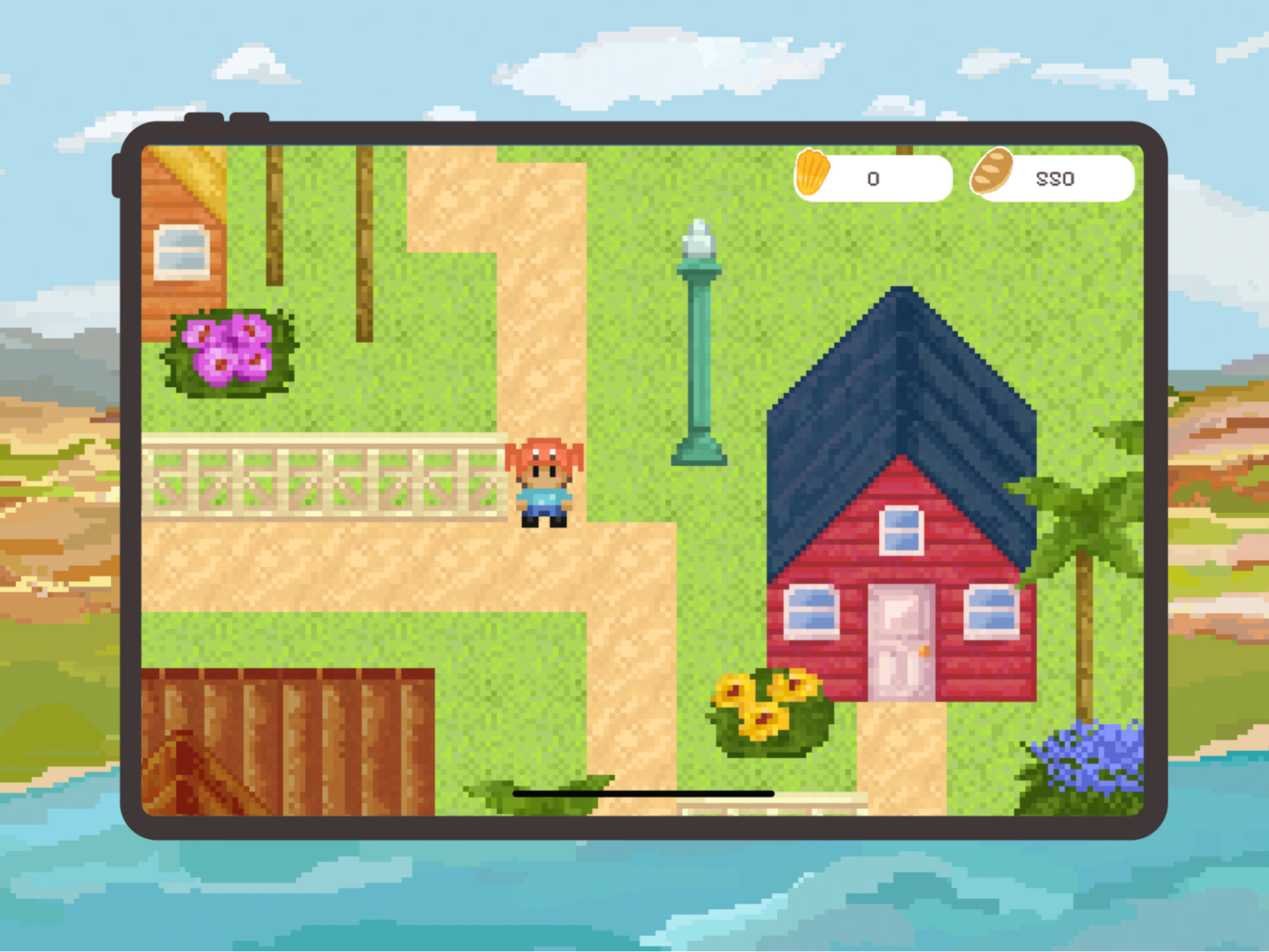
Palmier Island began as a self-funded prototype inside a crowded hacker house, where Chen developed the early pixel art and character designs on her own.
The premise is simple: the player arrives on a remote French-speaking island to cat-sit for an uncle who’s disappeared and leaves the main character with a million-dollar debt. They come to realize the house is locked, the essentials are missing, and every villager speaks a language the player doesn’t understand.
The way the game is set up, players use language through the island’s daily demands: helping out neighbors, tracking down missing essentials, and chipping away at the looming debt. Instead of handing out these tasks as assignments, Palmier Island leans on comfort loops and curiosity. The end goal is to encourage memory through meaning and repetition.
The world also seeks to enforce these notions by establishing patterns into regular play, with activities like running a café, helping out at small local farms, and speaking with fellow islanders. These are meant to be repeated just enough to make the game’s world feel more familiar as one keeps playing.
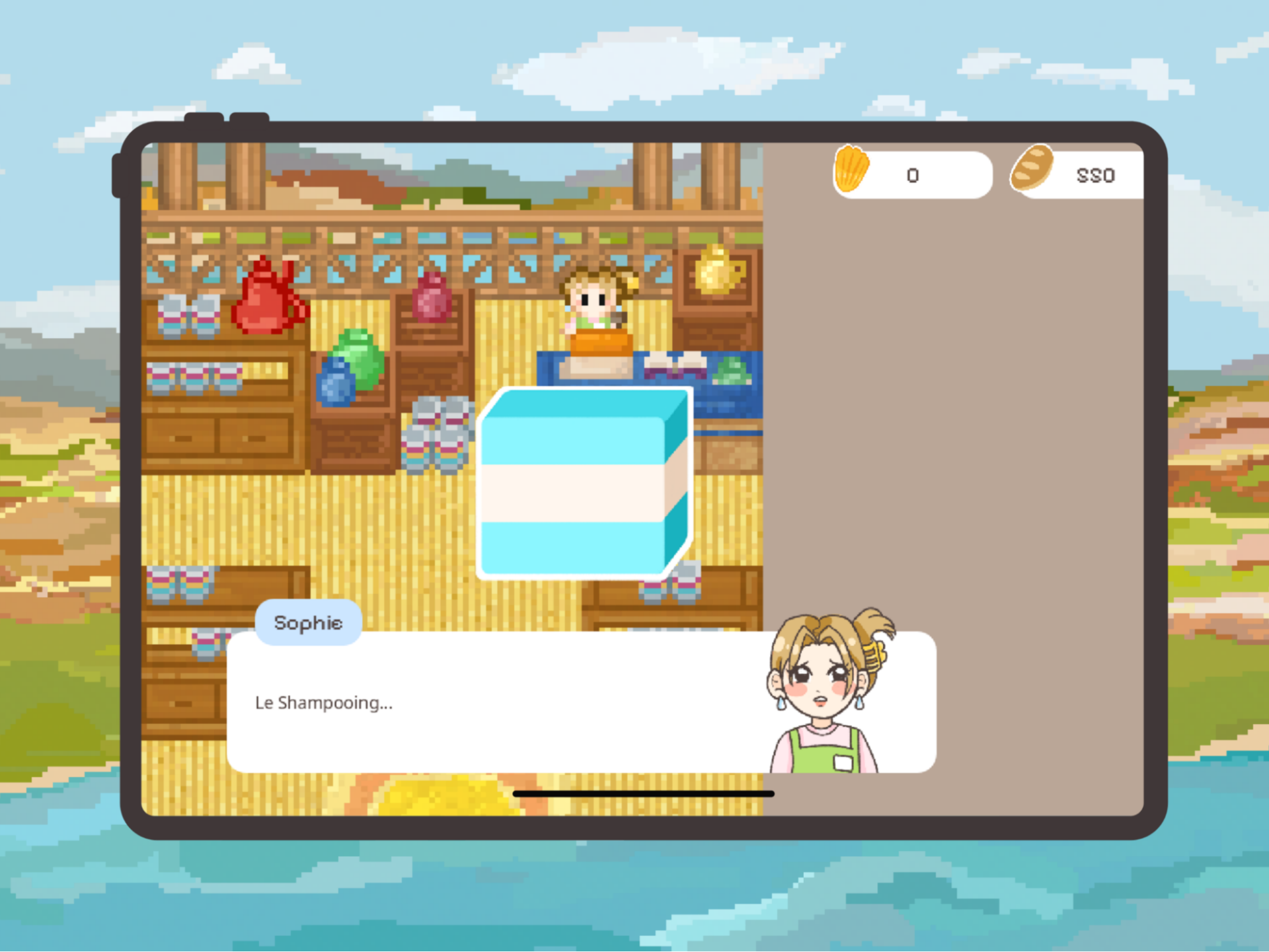
And through it all, learning becomes an integral part of a story through a “shop minigame,” where players are placed in scenarios where they need to pick up vocabulary like nouns or short phrases to make it through to the next level.
Chen describes this as “context over curriculum,” where the lessons stick in the memory because they need to in order to carry on with the story and the gameplay. As she explains, “When meaning is attached, retention spikes, and over time, you form associations built on that meaning. It’s inspired by Stardew Valley, except the debt adds urgency, like a narrative gun to your head: you have to learn French and you have to pay off the debt.”
Merging Regular Interactions With Action-Packed Battles
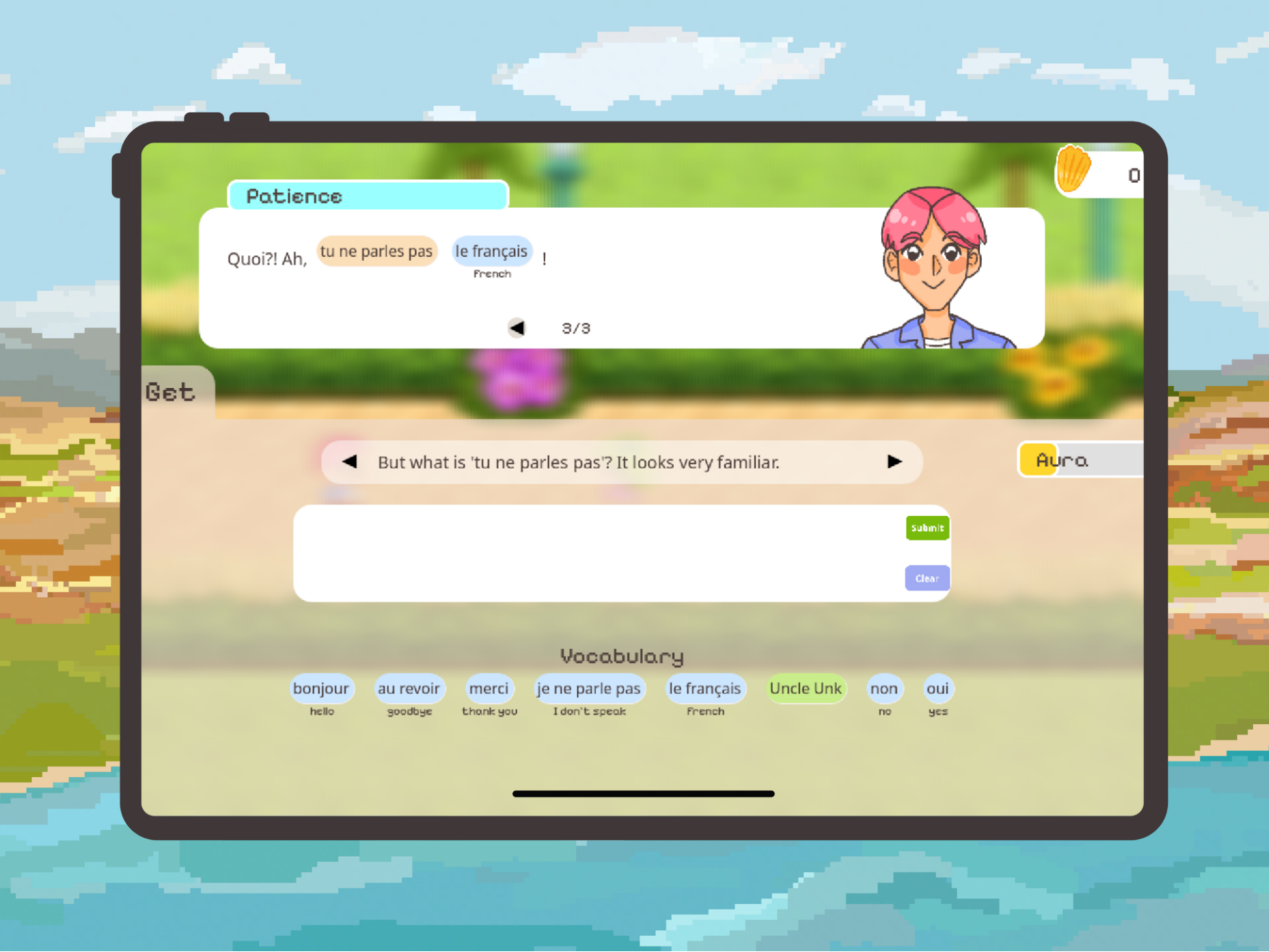
The signature gaming mechanic Chen has developed for Biscuit Games, present in Palmier Island, is what she calls “chattle” (a portmanteau of “chat” and “battle”). Inspired by her time in Milan and her interest in how people decode meaning under pressure, “chattle” seeks to reframe normal, everyday dialogue and turn it into something players can contextualize and strategically use to move the story forward.
Each line of NPC speech breaks into small word-chips, and players shift between two modes: one for capturing new vocabulary and one for replying with the words they’ve already collected. Every exchange acts as a sort of linguistic puzzle, where failed attempts reveal just as much as successful ones. The flow keeps tension light but purposeful, as it makes users engage constantly to get ahead in the game and reinforces the lessons players have already learned earlier in the game.
The chattle mechanic that Chen is establishing aims to show how narrative urgency can quietly drive cognitive learning without calling attention to itself. “Each word is a word chip — you capture it, then use those words back in reply, like a Pokémon battle where your moves are vocabulary you’ve learned from context,” she explains.
The People Behind The Operation
Biscuit Games operates as a small, remote team mainly located in Toronto. The studio’s structure is intentionally tight-knit, allowing artists, writers, and engineers to work in close collaboration while building work meant for a global audience.
The team also produces its own music, with Palmier Island’s full soundtrack composed in-house. It’s already out on all streaming platforms, part of the studio’s strategy to treat each title as a piece of original IP.
That handcrafted mindset is a core part of the studio’s identity. Chen remarks how a human is behind all art, music, and VO. Biscuit Games openly rejects AI-generated assets and seeks to keep its projects authentic and human-made, all based on the belief that the value of the work comes from the people behind it.
Making Learning A Playful Activity
Palmier Island’s early traction has been key to where the studio can go next. Early playtesters of the game doubled their planned session times, validating Biscuit Games’ “context-first” learning model and signaling that players were responding to something more than technically well-made gameplay.
The demo for Palmier Island is out now on the App Store, Play Store, and Steam. The demo promises to deliver survival-level French in its 30 minute to 1 hour runtime, and the team will be using the feedback from the demo to create future immersive and nutritious experiences.
Until then, Meisa Chen intends to keep moving forward with the vision that’s guided Biscuit Games from the beginning. In her words, “Biscuit Games will always be about world-building with heart — made by humans, for humans.”