LONDON — Remy AI‘s office looks less like a headquarters and more like the inside of a living computer. Exposed wires, microcontrollers, servos. Robotic hands rest on workbenches alongside humming 3D printers.
Ben Kaye, the company’s CTO, stands in the center of it all, fidgeting with a small geometric shape he’s just printed. At 26, Kaye has already caught the attention of Y Combinator and the Oxford Seed Fund, who are betting that his team can do what decades of industrial robotics have failed to: build machines intelligent enough to work alongside humans in the messy, unpredictable real world. For much of tech, “AI” happens behind a screen. Kaye is dragging it into the physical one.
At the heart of Remy AI’s work is a problem that has long limited robotics: teaching machines to handle objects they’ve never seen before. “Before, you had to have someone spend six weeks programming your robot to handle a particular box, a particular shelf, a particular sequence of movements,” Kaye says. “Now we’re able to deploy robots that naturally adapt to their environment without any of that.”
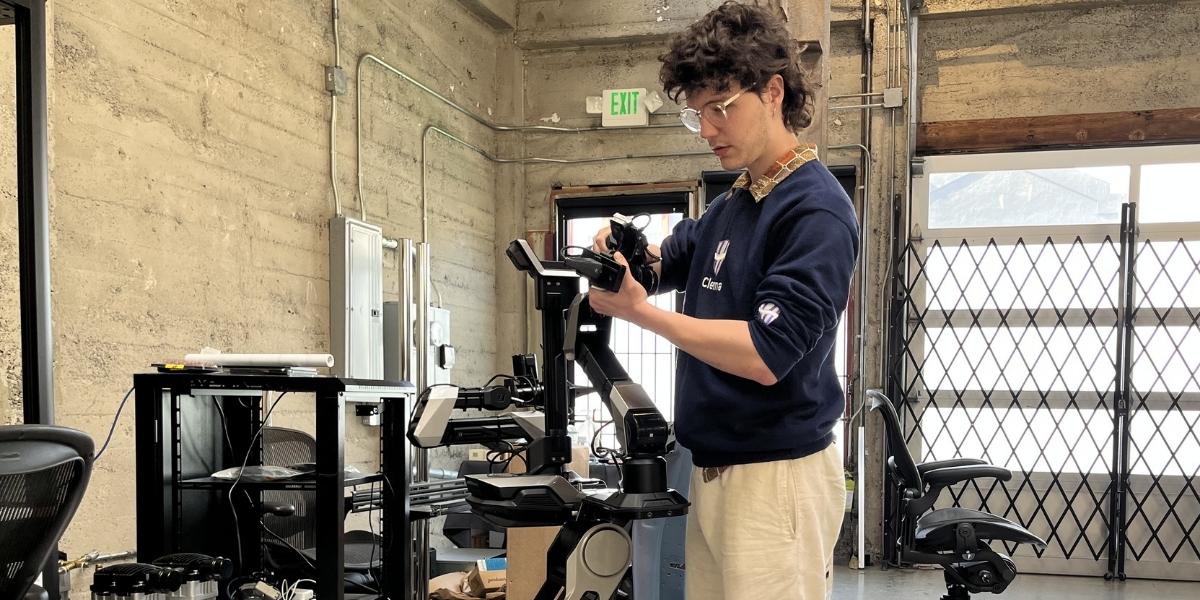
Photo Courtesy: Ben Kaye
The Hacker Mindset
Kaye’s path began in South London. The son of South African immigrants from Johannesburg, he attended Sutton Grammar, one of London’s top schools. By 12, he was teaching himself C++ to build command-line games, assembling 3D printers, and building his own PCs.
“I was always caught between the theoretical and the tangible,” he recalls. He landed on a principle that still drives him: “Physics is for discovery. Engineering is for people who want to change the world.”
Kaye studied Engineering at Oxford, graduating with a First and receiving prizes for his master’s thesis. He stayed on to pursue a PhD at the Visual Geometry Group, the lab behind some of the most cited work in deep learning and computer vision.
It was here that his pragmatic streak began to chafe. “I’d go to conferences and talk to people at massive tech companies, and their ‘everyday’ was just bureaucracy,” Kaye says. “These institutions force polymaths to specialize.” Academia had its own version: research that moved slowly and stayed locked inside papers.
That frustration boiled over when a highly cited robotics paper caught his attention: impressive results, but the authors hadn’t released their code. Kaye spent two weeks single-handedly recreating what had taken four researchers several months, then open-sourced the entire thing. Breakthrough research, he decided, shouldn’t sit behind closed doors.
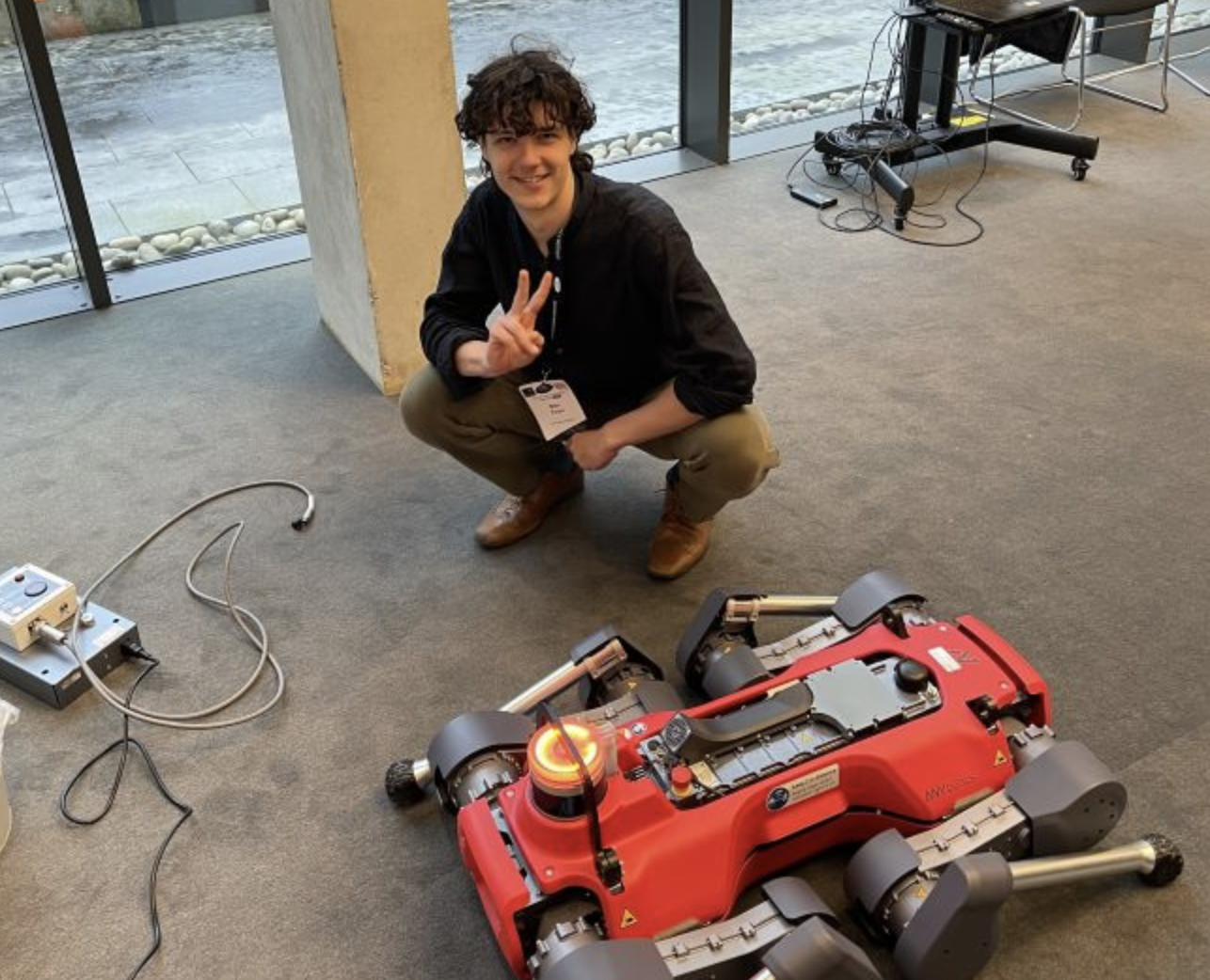
Photo Courtesy: Ben Kaye
Breaking the Barrier
Last year, Kaye dropped out of his PhD to build Remy AI with his friend Oscar Brisset from Oxford.
While giants like Amazon have poured billions into automated mega-hubs, over 80% of US warehouses remain almost entirely manual. Most existing automation is bulky, expensive, and rigid, unsuitable for logistics companies whose inventory shifts constantly. “It’s very difficult to justify machines that cost $150,000 or more when you might have to redesign your processes every six months,” Kaye says.
Photo Courtesy: Ben Kaye
This is where Remy AI helps, building robots that work within existing warehouse workflows rather than requiring a costly overhaul, learning to operate in “brownfield” spaces never designed for automation.
“We are moving into an era where AI finally makes it into the physical world,” Kaye says, setting down his 3D-printed fidget toy. “This is a trillion-dollar industry waiting to be unlocked.”