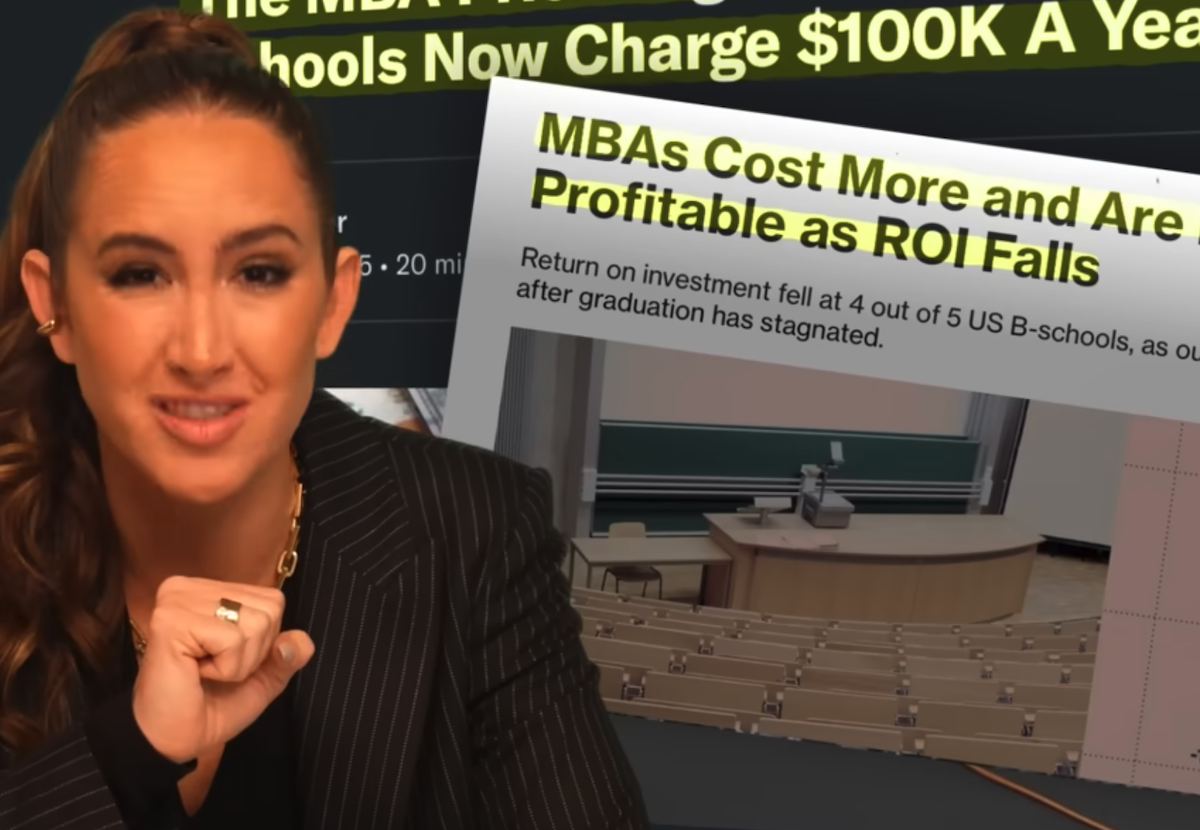
Business school once felt like the safest bet in town. Today, it looks more like a hedge against uncertainty than a path to real skill. I believe the better move is to learn by doing, and to build or buy a business while the opportunity window is wide open.
Cody Sanchez, an investor and educator, makes a blunt case: traditional MBAs are overpriced, outdated, and slow in today’s fast-moving market. Her argument isn’t an attack on learning. It’s a call to put practice over pedigree. That stance is hard to dismiss in an era where AI is rewriting job descriptions and small businesses need operators, not case-study champs.
The Core Argument
MBAs no longer match the speed or needs of real businesses. Employers want proof you can ship outcomes on Monday morning, not a diploma on the wall. Sanchez argues that many programs still teach frameworks from another era and are taught by people who haven’t carried a payroll or handled a lawsuit.
“If traditional business education were a stock, it would be the worst-performing investment of the next 20 years.”
She also hammers the point that elite networks aren’t the same as elite skills. Yes, top schools sell access. But access without execution is a costly illusion.
“The market no longer cares what’s printed on the diploma. It cares what you can do on a Monday morning.”
Evidence That Should Make You Pause
First, the job pipeline is shaky. AI-driven cuts in finance, big tech, and consulting have hit classic MBA landing zones. The old joke—no one got fired for hiring a big-name consultancy—sounds stale when those firms are trimming staff.
Second, the “MBA for entrepreneurship” pitch rings hollow in startup hubs. In Sanchez’s words, announcing an MBA at a Silicon Valley party draws eye rolls. It’s not that founders can’t have MBAs; it’s that an MBA isn’t how they learned to build.
Third, young workers are voting with their feet. Fifty-six percent of Gen Z say trades offer more job security. A third say white-collar work is less stable than it was for their parents. Enrollment in programs for electricians, HVAC, plumbing, and welding is climbing, and for good reason: three out of four home services are needs, not luxuries.
Fourth, look at the demographic wave. Japan offers a cautionary tale: in 2021, 44,000 businesses were abandoned, over half still profitable. The government warns that by 2030, 630,000 profitable companies could close, risking $165 billion and 6.5 million jobs. America is not Japan, but retirements here are real, and small firms need successors.
What Still Works—and What Doesn’t
Network matters. Top schools still open doors in certain fields. Some roles in private equity, high finance, or specific corporate ladders may justify the credential. I won’t deny that.
But the list of jobs where the MBA is the ticket is shrinking. Curricula move at DMV speed; markets move at warp speed. Two years and $200,000 to emerge with skills that peaked in 2017 is a poor trade for most operators.
A Better Path For Builders
If you want to run a plumbing outfit, a car wash, a laundromat, or a logistics shop, you need reps, not theory. Sanchez argues for an “active education” model: real deals, live feedback, daily coaching, and community. In short, training that tracks the problems owners actually face—hiring, cash flow, lawsuits, broken equipment, spikes in demand.
- Buy or join a simple, profitable business with steady demand.
- Stack practical skills: sales, service ops, basic finance, hiring.
- Learn fast loops: test, measure, fix, repeat.
- Build a peer network that reviews your real decisions.
That approach isn’t theory. It’s how many operators win every day. And it costs a fraction of a traditional path.
Why This Matters Now
America files more than five million small-business applications each year. That is our engine. If we keep feeding it with owners who can execute, we protect jobs, towns, and the tax base. If we don’t, we risk a slow bleed like Japan’s. The stakes are local and national.
My view is simple: if your goal is to build or own, skip the letters and get to work. Learn in the arena. Use mentors. Use modern, applied programs. Buy something boring and excellent. The return is skill, control, and community impact.
Conclusion: Choose Skill Over Status
I’m not anti-education. I’m anti-expensive detour. If you want to operate, choose learning that forces outcomes and helps you own equity. Support trade programs. Apprentice with a small firm. Join an operator community. Consider acquiring a steady service business. Then improve it one process at a time.
Stop renting status. Start building cash flow. The country needs owners. Your town needs one more good shop that shows up on time. Let’s make that you.
Frequently Asked Questions
Q: When does an MBA still make sense?
Certain finance, consulting, or corporate strategy roles may still value the credential. If your target employer openly requires it, and the ROI is clear, it can be worth it.
Q: How can I learn to run a small business without school?
Work inside a local service company, take on responsibility fast, and use applied programs with coaching and live deal reviews. Focus on sales, ops, and cash flow.
Q: What kinds of businesses are durable right now?
Trades and home services with recurring, urgent demand—plumbing, HVAC, electrical, cleaning, logistics, and laundromats—tend to hold up and aren’t easily replaced by software.
Q: How do I assess whether to buy a business or start one?
Check three things: existing cash flow, simple operations, and your ability to run it day one. If the numbers work and you can operate, acquisition often beats a scratch start.