As the United States competes in a global economy increasingly defined by advanced technology, manufacturing, and scientific discovery, one question has become central to its economic future: How does publicly funded research become jobs, companies, and national advantage?
That question is not new. In 2009, as federal research funding came under heightened scrutiny in the aftermath of the Great Recession and university budgets tightened across the country, Dr. Paul R. Sanberg, FNAI, began asking a version of it that few of his peers were at the time: Who, inside American universities, was actually turning research into economic impact?
While policymakers closely tracked small businesses and traditional entrepreneurs, a growing class of federally funded academic inventors, scientists and engineers launching companies, creating jobs, and commercializing breakthrough technologies, remained largely invisible within both public policy and academic recognition systems.
That gap would eventually inspire the founding of the National Academy of Inventors.
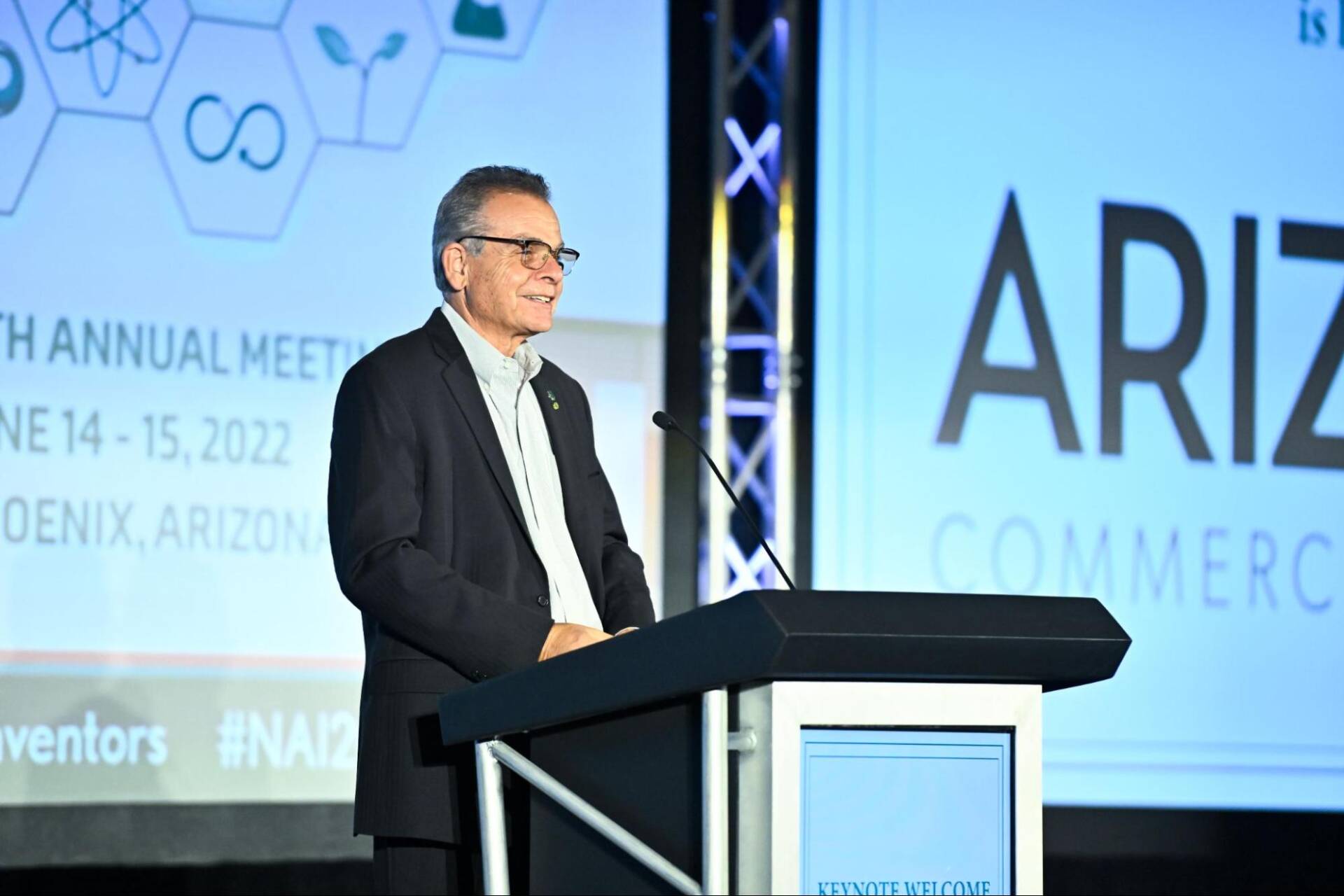
Dr. Paul R. Sanberg, FNAI, addressing new NAI Fellows at the 11th Annual Conference Signature Gala in 2022 (Credit: Mark Skalny Photography)
At the University of South Florida, where Sanberg served as Vice President for Research, Innovation, and Knowledge Enterprise, he decided to test his intuition. He invited every faculty member who held an issued U.S. patent to a luncheon, uncertain how many would attend.
More than 100 researchers from across disciplines showed up.
For Sanberg, the turnout was a revelation. It became clear that universities were home to a large and productive community of inventors, but almost no system existed to recognize them, measure their impact, or learn from their experience.
Established in 2010, the National Academy of Inventors became the fourth modern national academy in the United States. Unlike existing academies focused primarily on scholarship or discipline-specific excellence, NAI introduced a new model: one that recognized academics not only for discovery, but for invention, commercialization, and real-world impact.
At the time, patents were often viewed as secondary to publication within many universities, and invention rarely factored into promotion or recognition systems. NAI was intentionally designed to challenge that paradigm by elevating faculty innovators whose work strengthened communities, industries, and the national economy.
“Our objective has always been to ensure that America’s brightest minds are recognized not only for discovery, but for impact,” Sanberg said. “Invention, commercialization, and job creation are essential to economic growth, national security, and solving the challenges society faces.”
Since its founding, the Academy has partnered closely with the U.S. Patent and Trademark Office to recognize inventors whose work drives advancement across the national innovation landscape and to develop programs that support researchers as they bring ideas to market.
Dr. Sethuraman Panchanathan, former Director of the National Science Foundation and Fellow of the NAI, and an NAI Board member, said the work of the Academy is focused on addressing a critical gap at a pivotal moment in our nation.
“For decades, we measured academic success almost entirely through scientific publications,” Panchanathan said. “NAI has helped expand the conversation on how research translates into innovation, economic growth, and national competitiveness. This message is apt for this moment in our country.”
Today, the economic footprint of academic invention is difficult to ignore. Across its fellowship, NAI inventors have helped launch more than 4,000 companies and startups and create an estimated 1.4 million jobs, according to Academy data. Collectively, they hold more than 86,000 U.S. patents and thousands of licensed technologies spanning fields from biomedical engineering and energy to artificial intelligence and advanced manufacturing.
For policymakers and university leaders alike, those numbers underscore the lesson that motivated NAI’s founding: invention inside universities is not an abstract academic activity. It is a core driver of economic growth.
This year marks a significant institutional milestone for the Academy. In June, NAI will host its 15th Annual Conference, the organization’s central forum for recognizing new Fellows, convening research leaders, and reflecting on the evolving role of invention in higher education and national policy.
That tradition of recognition will take on a distinct new significance on February 11, National Inventors Day, when the names of the Academy’s newest class of Fellows will be formally entered into the U.S. Congressional Record by Representative Kathy Castor of Florida. While the Congressional Record has recognized inventors before, this will mark the first time the Academy’s Fellows are honored in this way on a day dedicated nationally to invention itself.
The gesture is symbolic, but its meaning is unmistakable: Invention inside American universities is no longer a peripheral activity. It is now part of the nation’s official historical record.
For Sanberg, the moment reflects how far the idea behind NAI has traveled, from a single campus luncheon to a national institution whose members’ work is recognized not only by their peers, but regularly by Congress itself.
As global competition accelerates, the Academy’s founding premise is clear: the strength of the nation’s research enterprise depends not only on discovery, but on translating ideas into economic and societal impact.