At first glance, it may be tempting to assume that, when it comes to education, presenting students with more material in a shorter period of time should naturally lead to more learning.
Recent research shows that this logic doesn’t apply to real-world education; however, it instead reveals that lasting learning comes from sustained attention, real engagement, and meaningful relationships. Schools that emphasize a balanced, human-centered approach to learning are therefore better able to help students grasp and maintain concepts in ways that support lasting retention and critical thinking.

The Pitfalls of Speed-Driven Models
Many microschools, i.e., schools whose classes typically pair ten or so students with each teacher, focus on establishing and adhering to compressed timelines or tech-driven shortcuts that, while densely packed with content, don’t necessarily lead to better learning outcomes.
Cognitive science suggests that compressing material doesn’t lead to deeper understanding but rather to a tendency toward surface recall and even burnout, limiting the little learning this approach provides. Conversely, true learning requires time, specifically to allow for greater reflection, application, and revisitation of concepts in a relational context.
What Research States About Deep Learning
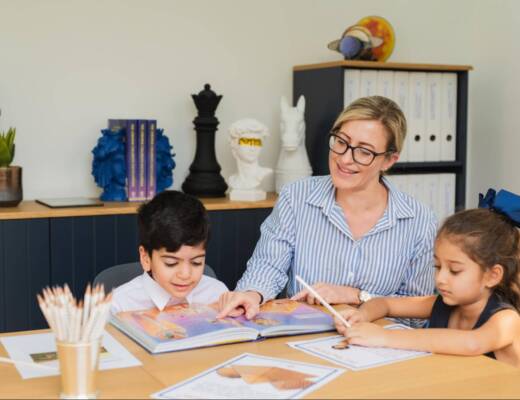
Research in cognitive neuroscience and education consistently shows that sustained attention and emotional engagement are central to long-term retention and critical thinking. Studies associated with the Wharton Neuroscience Initiative have explored brain synchrony, the alignment of neural activity between individuals during shared learning experiences, demonstrating that learning is measurably strengthened when students are actively engaged with teachers and peers rather than consuming information passively.
This research highlights the importance of guided discussion, social interaction, and mentorship in supporting healthy brain development in children. When learners participate in shared problem-solving, dialogue, and collaborative exploration, their attention deepens and understanding becomes more durable. By contrast, passive or isolated content consumption shows significantly weaker outcomes for comprehension and long-term learning.
Equally important, students need time and space to explore ideas at their own pace. Environments that allow for feedback, interaction, and individualized guidance help learners form connections, build confidence, and develop critical thinking skills. Because no two students process information in the same way, cooperative, discussion-based learning becomes essential—not optional—for meaningful educational outcomes.
Technology as a Support, Not a Substitute
Digital education tools, especially those powered by AI, have become increasingly prevalent in recent years. While these tools can enrich learning, they are most effective when guided by strong educators who can adapt and respond to student needs. Simply put, algorithms lack the capacity to notice, question, or mentor in the same ways as strong educators, thereby limiting their ability to apply much-needed relational teaching.
When educational tools and other forms of technology take precedence over the teaching process itself, opportunities for dialogue and connection often diminish. In reducing access to learning by conversation, opportunities for deeper thinking tend to diminish in turn.

Masterminds Academy: A Research-Informed Alternative
Despite the growing prevalence of technology-led instruction, particularly within microschool models, where digital tools increasingly replace human collaboration, this approach is not universal. The Los Altos–based microschool Masterminds Academy offers a contrasting model grounded in what learning science consistently supports: small groups of five to six students, thoughtful pacing, and responsive, teacher-led instruction.
Rather than isolating subjects or accelerating content delivery, Masterminds takes an integrated approach to learning, one that spans academics, languages, music, physical development, and applied innovation. These domains are intentionally connected, reinforcing how children naturally build understanding across disciplines rather than in silos.
The school’s model prioritizes depth over speed, enabling stronger relationships between teachers and students and supporting sustained cognitive and personal development. Learning is structured to encourage discussion, collaboration, and reflection, giving students the space to develop not only knowledge, but judgment, confidence, and the ability to work meaningfully with others.
That learning is further extended beyond the classroom through carefully curated real-world experiences, including sailing, golf, and advanced outdoor expeditions. These settings provide opportunities for students to apply concepts in unfamiliar environments, strengthening adaptability, leadership, and problem-solving skills in ways traditional classroom instruction alone cannot replicate.
While efficiency in processing information has its place, Masterminds’ approach recognizes that content mastery alone does not produce well-rounded learners. The ability to apply knowledge, collaborate under changing conditions, and think critically in real situations is increasingly essential, particularly in the kinds of complex, high-performance environments students are likely to encounter later in life. By grounding learning in research, relationships, and real-world context, the model reflects how deep understanding is formed, and sustained, over time.