Professional pastry-making has long been defined by its scientific rigor and exacting demand for precision. As such, success has often required symmetry and flawlessness made possible only through masterful control of mass, temperature, and technique. A growing number of chefs, however, are beginning to move away from strict perfectionism, embracing an approach to dessert that allows greater room for individuality and expression.
Early Impressions of Food
Chef and cake decorator Gianne Itaralde has taken part in this movement to convey the emotional weight food carries for her family and culture. Raised in the Philippines in the family behind the catering and events business Acacia Alley, Gianne grew up understanding that food is as important for emotional sustenance as it is for biological sustenance. “Food was never just food,” she says. “It was how my grandmother loved people. It was how she remembered them.”
Despite this early exposure to food-as-connection, Gianne didn’t initially intend to pursue cooking. Instead, she opted to study business at De La Salle University before exploring aviation, car sales, and event styling, driven by a desire to be challenged.
It was after participating in these formative detours that she decided to study culinary arts in order to deepen the range of experience she wanted to bring to the family business. Her prior experiences and education also proved valuable in shaping that business, providing her with the communication skills, resilience, and visual storytelling needed to succeed.
A Turning Point in Pastry
The direction of Gianne’s life changed after participating in a one-week pastry module as part of her culinary arts studies at École Ducasse Manila. Although the experience was only meant to serve as a brief moment of exposure to something new, it became a professional pivot unto itself. “Out of all the industries I had worked in, this was where I finally felt at home,” she recalls. She subsequently enrolled in the full Pastry Arts program and later trained at The Peninsula Manila, where she refined her work in chocolate, bread, and petit fours before moving to New York City to join The Mark Restaurant under Jean-Georges.
Gianne quickly found the contrast between Manila and New York to be stark but instructive, as New York’s high-intensity kitchens, precision, and pace proved to be uncompromising. “The standard is exacting,” she says. “But you also learn very quickly who you are under pressure.”
Exposure to diverse techniques and cultures broadened Gianne’s perspective on flavor, particularly in the interplay between savory and sweet. She now experiments with combinations such as miso caramel and chocolate accented with soy sauce to challenge conventional pastry boundaries.
Embracing the Humanity in Creation
Gianne’s unconventional perspective on what pastry can and should be reflects a broader conversation within the industry about authenticity and craftsmanship at a time when social media amplifies algorithm-friendly aesthetics.
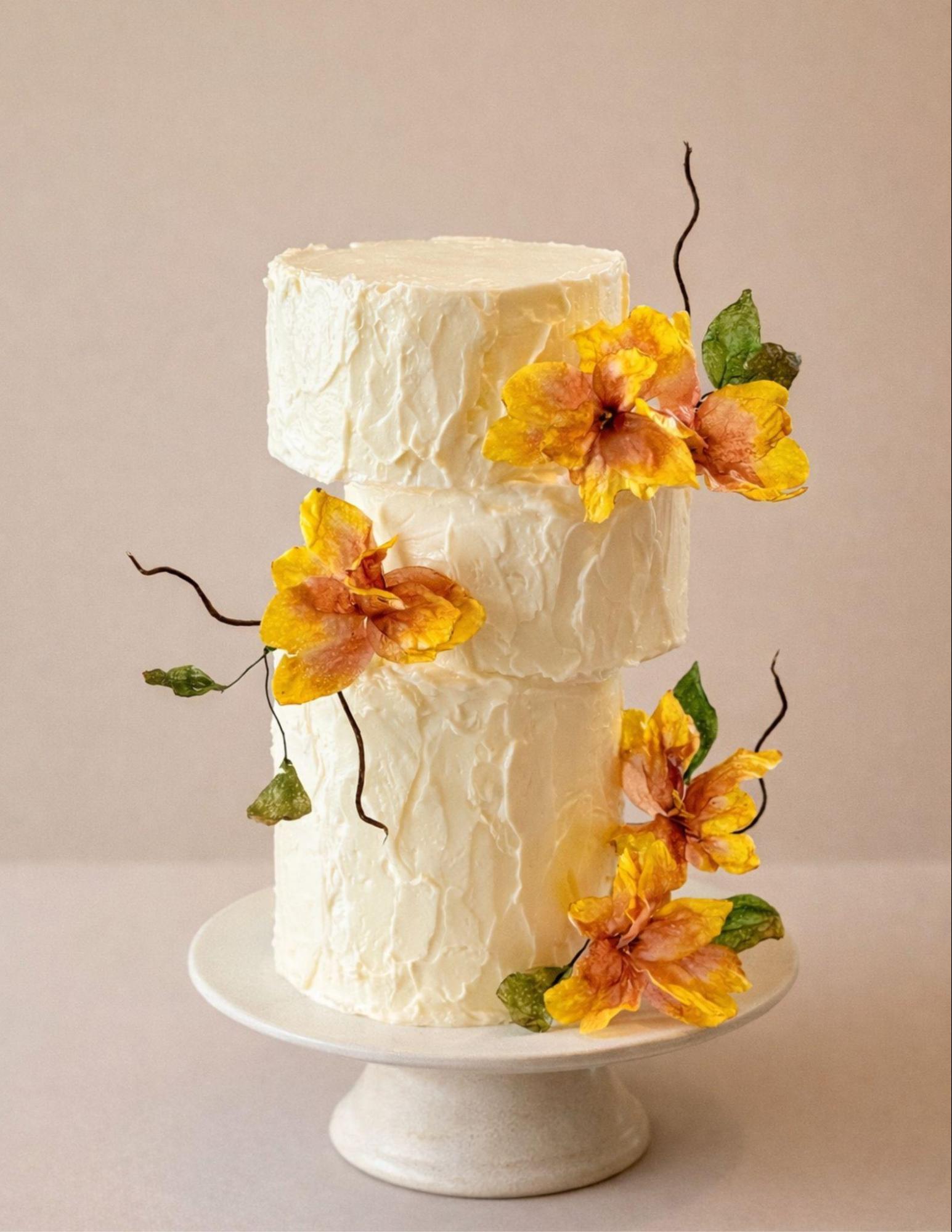
Hyper-polished cakes and technical mastery often dominate these spaces due to their broad appeal, but some chefs are gravitating toward designs that reveal and celebrate the human aspects of creation. Gianne herself draws inspiration from the Japanese concept of wabi-sabi, a philosophy that finds beauty in imperfection and transience.
“As a recovering perfectionist, I had to learn to let go,” she says. “Rustic textures, asymmetry, movement. They show that something is made by a person, not a machine.” For Gianne, pastry serves as the meeting place between art and science, but she points out that art suffers when technical control overshadows expression. “You need structure,” she adds, “but you also need space for the design to breathe.”
Today, the balance between structure and expression has become more relevant than ever due to the ongoing influence automation and artificial intelligence exert on food production and visual culture. These technologies improve consistency and efficiency, but Gianne notes that they may also heighten the value of individuality. “In a world pushing everything toward flawlessness, the more I value work that feels honest and human,” she says.
Understanding Collaboration in Cooking
Veterans in the pastry industry often emphasize discipline, stamina, and technical mastery, qualities Gianne believes are still vital to working in physically and mentally demanding kitchens. “This is not something to approach casually,” she says. “Long hours, missed holidays, pressure, cuts and burns are real.” She advises newcomers to approach the industry with curiosity, teamwork, and adaptability to prepare for these conditions. “Pastry is where science and art meet. Understanding ingredients, temperature, and timing. There is always more to learn.”
Gianne’s perspective also reflects the importance of collaboration in professional kitchens that employ the brigade structure, explaining that “no one survives the industry alone.” For her, flavor balance remains as valuable as the ability to multitask, anticipate, and communicate.
Letting Pastry Be More Than Food
As steeped in discussions of technique and discipline as she is, Gianne regularly returns to her memories, one of the most important being about her grandmother and the family gatherings she frequently hosted. “Since her passing, cooking is how I remember her,” she says. “It’s how I carry her love forward.”
Looking ahead, Gianne aims to grow her creative practice in pastry, especially in custom cakes and events. She explains that her ambition comes less from scale and more as a matter of intention, stating, “I want to build something rooted in care and sustainability; a place where creativity is protected and work doesn’t come at the cost of a life.”
Pastry as an art form will continue to grow, develop, and adapt as perspectives on the right balance between technical rigor and artistic freedom change in turn. Chefs like Gianne Itaralde suggest that the future of dessert may not lie in flawless surfaces alone, but instead in cakes that tell stories and carry memories made apparent through the imperfect details that are a natural and welcome byproduct of human creation.